
Humans need nature. Just think how much time – when you can – you spend outdoors. Walking in the park or woods at the weekends is very common in the western hemisphere. In this region, these outdoor activities are being encouraged with the building of many parks and green outdoor public areas as possible. Being in nature soothes us, makes us smile, makes us happy!
But we spend most of our time indoors and a large portion of that at a workplace. Companies often don’t add plants, because they look at the initial purchase costs and the following maintenance costs. But there are plenty of scientific studies showing how simply adding a few plants to the office space boosts productivity and job satisfaction. And these hidden savings are considerable for company owners to take note and see that investing in plants at the workplace is a wise idea.
Reduce Stress & Increase Productivity
Already adding one plant changes the atmosphere in the office space. It makes the space, more engaging and more calm at the same time.
It has been shown that plants placed in hospitals make the patients heal faster. Students learn better in a green surrounding. And employees with plants at their workplace are more productive, make less mistakes, take less days off being sick. Seeing a plant from where you sit or simply touching it when walking past brings happiness. It makes you feel more alive and energized. But the effect is also seen in the quality of work produced: employees perform much better and at a higher accuracy rate, when surrounded by plants. Simply put in numbers:
Tension/Anxiety – 37% reduction
Depression/Dejection – 58% reduction
Anger/Hostility – 44% reduction
Fatigue – 38% reduction
Productivity – 15% increase
Memory retention – 20% increase

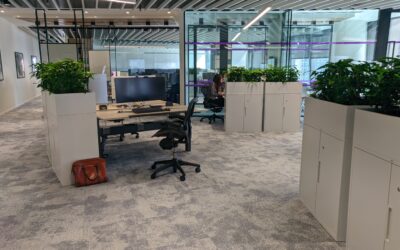
(Image: Chinese company specialized in AI engineering: ‘one workplace, one employee, one computer, one plant !’.)
Improve Air Quality
We work in a A/C and computerized run world and it isn’t healthy. Studies show the indoor air is even more polluted than outdoor air. Typical air pollutants at a workplace are asbestos, mould, radon, formaldehyde and carbon monoxide. Further we have computers, laptops, mobiles and other electronics around us, emitting radiation of different degree. All these effect our health, causing for example headaches, dry eyes, dry throat or fatigue.
Plants oxygenate the air. Research show that plants work as a filtering system – especially when you have hydroculture plants. Generally the toxins & radiations get absorbed by the leaves and plant roots. Since a hydroculture plant system is purely water based, without any soil, the toxins get sent through a second filter system: water. There is a common saying: one computer, one hydroculture plant.
Additionally a hydroculture plant works as a humidifier: cleaning up the dry A/C filtered air and releasing moisturized air. Each hydroculture plant takes approx. 5 liter of water. Only 1/3 is used by the plant, 2/3 are released into the surrounding, actively changing the quality of the air around you and reducing the need for A/C even.
So which plant do you select?
The answer is simply: any! And as many as you want. As experts in the field of indoor landscaping with hydroculture since 1980, we are most happy to help you select the right plant for the right area. Light is an important factor to consider. But the variety of plants that thrive even in rooms with a minimum of light has grown so much and is increasing year by year, that selecting a beautiful plant will not be a problem. And if necessary there are growing lamps which produce a balance of cool and warm light.
And never forget that with hydroculture plants your regular maintenance cost simply falls away. So there should be even less of a reason not to start beautifying your office space with plants right away!